
Transforming the logics that guide action
I work on the logics, behaviours and tensions that determine an organisation’s capacity to transform.
Sparring Partner • Cultural Transformation • Adaptive Leadership
30+
years in the field
30
countries of intervention
5
working languages
4
continents
Decisive transformations rarely begin with a process.
They begin with a clear-eyed conversation about what truly governs decisions, behaviours and trade-offs — and with concrete actions capable of shifting the system.
Organisations do not transform at depth because a process, an organisational chart or an action plan is changed.
They transform when they make visible the logics that truly govern decisions, behaviours and trade-offs under pressure.
This is where I intervene: at the intersection of culture, leadership, governance, operative values and collective capacity for action.
What I bring
Three levers of intervention. One underlying logic.
Sustainable change does not come from a generic solution. It comes from rigorous work on what an organisation believes, tolerates, protects, avoids — and makes possible.
01
Cultural transformation & change management
Cultural diagnosis. Strategic seminars. Executive retreats. Bespoke intervention architectures.
I work on the gaps between stated values and values in action, zones of friction and limiting behaviours. My intention: to create the conditions for an aligned culture — more coherent, more credible and more effective.
In practice? Starting from real values, putting frictions to work, identifying the key values, translating them into expected behaviours, then training managers to embody them.
02
Adaptive leadership & executive development
Individual and team coaching. Management development. Work on real dilemmas.
Beyond posture and competency frameworks, leadership is forged in uncertainty — through the practice of regulating tensions, reading value and belief systems, and engaging other actors to grow while working through them.
What gets worked on? Introspection, enabling and limiting beliefs, vision, scenario planning, agility, team facilitation and difficult conversations.
03
Collective intelligence, coalitions & community development
Strategic facilitation. Building coordination mechanisms. Inter-institutional work. Cooperation architecture.
I help actors with different cultures, interests and positions — sometimes competing, often distrustful — build spaces for cooperation without diluting their differences.
How? By enabling trust, transparency, mutual understanding, coordination, collective discipline and ecosystem development to emerge.
What sets me apart
Crossing boundaries. Reading systems.
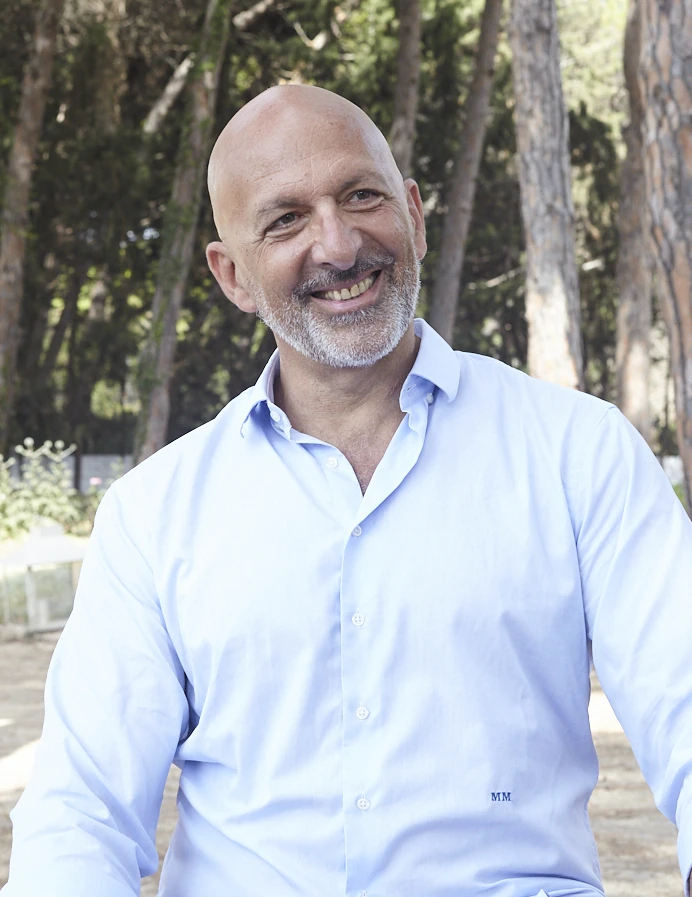
Born in Israel. Educated between France and the United States. Based in Barcelona.
More than thirty years of interventions across Europe, the United States, Africa, China and beyond.
I have worked with Executive Committees, CEOs and senior leadership teams, management teams, foundations, international public organisations, Jewish institutions and multi-stakeholder coalitions.
This dual practice — private companies on the one hand, mission-driven organisations on the other — is not a biographical detail. It is a school of reading contexts, power dynamics, cultures and collective dilemmas.
Dilemmas are often universal; credible answers are always contextual.
A singular practice
Between business transformation and collective resilience
Part of my work takes place in business settings, at the intersection of organisational learning capacity, adaptive leadership and collective intelligence.
Another part is rooted in the European Jewish world, where I help organisations address challenges of coordination, philanthropy, community development and cultural transformation with adaptive, sustainable responses.
This second field is not simply another sector. It enriches my understanding of organisations that must act under constraint. Complexity, memory, fragmentation, minority status, transmission, political uncertainty and the coexistence of strong differences are not background factors; they shape the conditions for action. The challenge is to hold diversity together without making it uniform.
From one field to another, the same principles guide the intervention: start from real needs, strengthen existing capacities, structure useful tensions rather than multiply programmes, cultivate reflexivity, and enable aligned collective action to emerge without overloading the system.
Approach & method
Values-based. Not a posture. A method.
I do not intervene as an expert who observes from the outside, produces a report and disappears.
I intervene as a sparring partner: present in the ring, attentive to visible and invisible dynamics, rigorous in diagnosis, incisive in deliberation and precise with language. Because when language loses precision, problems remain poorly named, poorly defined — and rarely worked on at the right level.
01.
Diagnose before prescribing
Understand what is really at stake: unspoken issues, frictions, contradictions, loyalties, legitimate resistance, blind spots and the invisible dynamics at play.
02.
Create safety without paralysis
Without trust, no vulnerability is expressed. Without confrontation, nothing changes in depth. Listening, acknowledging emotions and respecting singularities create safety; difficult conversations open the way. My role is to hold that tension with precision.
03.
Work on real dilemmas
Do not treat symptoms alone. Put to work the tensions that structure the life of the collective. Stability or evolution. Belonging or openness. Autonomy or coordination. Loyalty or transformation. Individual or collective. This is where I intervene.
04.
Translate values into behaviours
Culture does not change by being displayed. It changes when values alter the way people decide, manage, cooperate and regulate. Without that, values decorate. With that, they transform. Cultural engineering aims here for a more robust alignment between expressed values and observed behaviours.
05.
Co-construct without complacency
An imposed transformation rarely holds. A co-constructed transformation holds better — provided participation is not confused with a lowering of standards. My role is to create a frame in which disagreement becomes work rather than blockage.
06.
Anchor the work over time
The real work happens between sessions: in experiments, signals from the field, adjustments, difficult trade-offs, reworked scenarios and collective learning. It is through that repetition that an organisation’s adaptive capacity is built.
Types of situations I work on
When to call me in
01.
A strategic transformation is stalling despite solid processes and clear intentions
02.
An organisation wants to restore clarity, momentum and the capacity to act without adding another layer of complexity
03.
An organisation needs to navigate a sensitive phase — growth, crisis, recomposition or transition — without losing its sense of direction or its capacity to mobilise
04.
Gaps between stated ambition, actual practices and everyday ways of working are slowing the system’s evolution
05.
An executive committee needs a space for productive confrontation to clarify its disagreements and strengthen collective ownership of its decisions
06.
A leadership team needs to distinguish technical problems from adaptive challenges that require deeper work
07.
Leaders are facing challenges for which the answers are not written in advance and must be built with the people across the organisation
08.
A leadership team needs to strengthen its collective memory to build strategic continuity and sharpen execution
09.
Tensions between teams or entities are hindering execution, and the company needs to make cross-boundary cooperation a deliberate workstream
10.
Cultural frictions, unspoken issues and implicit ways of working are undermining cooperation and draining the system’s energy
11.
An executive committee needs to move beyond “information / alignment” and become a real collective work forum, with a regular discipline for working through issues brought by its members
12.
Multiple actors need to learn how to cooperate without neutralising one another
Support formats
Bespoke formats for non-standard challenges
Executive sparring
Senior leadership team coaching
Cultural engineering and transformation architectures
Cultural diagnosis
Facilitation of strategic bodies
Architecture of coalitions and coordination mechanisms
Workshops to clarify values, behaviours and trade-offs
Executive seminars and retreats
Adaptive leadership programmes
Social proof / credibility
A practice shaped by diverse contexts
Companies, international groups, agencies, institutions, foundations, community organisations, media, logistics, the public sector and the non-profit world.









Decisive transformations begin somewhere other than in processes.
They begin when a collective commits to looking lucidly, naming what blocks progress and testing, together, other ways of acting.